
The Pacific Innovation Forum for Climate and Environment (PIFCE) 1st - 3rd July, 2026



Brief overview
The International Organization for Migration (IOM) is the leading UN agency on migration, working across the Pacific to saving lives and protecting people on the move, driving solutions to displacement, and facilitate regular migration pathways, guided by the IOM Strategic Plan 2024-2028. IOM has offices in 10 Pacific Island countries including Fiji, Federated States of Micronesia (FSM), Palau, Papua New Guinea (PNG), Republic of the Marshall Islands (RMI), Samoa, Solomon Islands, Tonga, Tuvalu, Vanuatu, as well as operational engagements and activities in Cook Islands, Kiribati, Nauru, Niue, Tokelau. IOM is committed to supporting Pacific regional, national and local priorities.
Your organisation’s goals
The International Organization for Migration (IOM), as the leading intergovernmental migration agency, has been at the forefront of operational, research, policy and advocacy efforts, relating to the nexus climate change, environment, and human mobility, alongside Member States, observers and partners. With a strong focus on the Pacific’s acute exposure to climate‑ and disaster‑related risks, IOM supports governments and communities to prevent, reduce, and address climate‑induced displacement through evidence‑based policy advice, climate mobility research, and the integration of human mobility into national adaptation, disaster risk reduction, and development planning. In the Pacific, IOM’s services span disaster preparedness and response coordination, climate change adaptation and resilience building, planned relocation and migration governance, and protection of displaced and at‑risk populations.
The Pacific Regional Framework on Climate Mobility (PRFCM) was developed, and continues to be implemented, through a member state-driven, collaborative process supported by the IOM-led Pacific Climate Change Migration and Human Security (PCCMHS) Programme, and involving all Pacific Island Forum Members, partners and stakeholders. IOM, PIFS and partners support a regional ecosystem that enables climate mobility action and supports practical, time-bound implementation at the country level through integrated, action-oriented approaches.
Describe your innovation
Innovation: Cross Sector Interactive Climate Mobility Training Tools for the Pacific
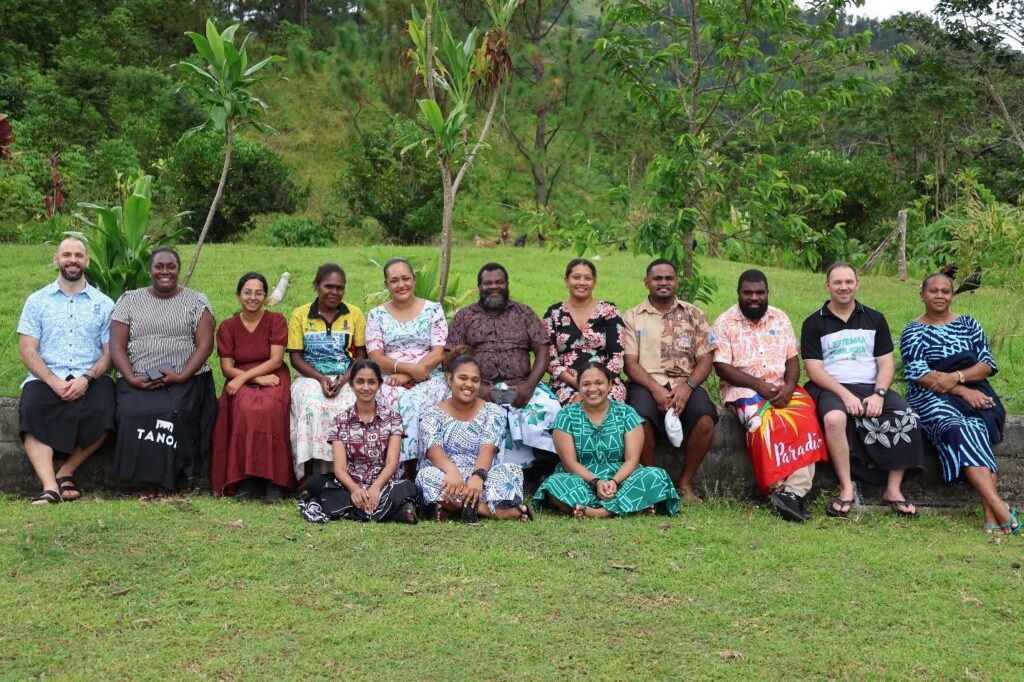
One innovation we wish to feature is our suite of interactive climate mobility training tools designed to be used across traditional silos of government, civil society, and communities, as well as promote intergenerational learning. The tools are tailored for a wide range of stakeholders—from children and youth, to community leaders, civil society organizations, technical officers, and senior government decision makers—creating a shared learning platform on climate related mobility in Pacific Island Countries and Territories (PICTs).
The innovation addresses climate change and environmental challenges by strengthening understanding of how sea level rise, coastal erosion, extreme weather events, and ecosystem degradation influence human mobility. Through scenario based simulations, serious games, and facilitated dialogue, users explore real world climate mobility pathways such as planned relocation, disaster displacement, labour mobility as adaptation, and urbanization. Importantly, the tools emphasize anticipatory and preventive approaches, enabling stakeholders to assess risks and policy trade offs before crises occur.
A defining feature of this innovation is its ability to bridge institutional and sectoral divides. Climate mobility is often fragmented across mandates—environment, disaster risk management, land, housing, labour, education, and social protection—while civil society and communities are engaged late or inconsistently. These tools bring actors together in a shared, participatory learning space, fostering a common language, mutual understanding, and coordinated responses across ministries, local authorities, NGOs, faith based organizations, and community groups.
The tools are particularly relevant for PICTs as they are grounded in Pacific realities, including customary land tenure, strong cultural ties to land and ocean, and the importance of collective decision making. By supporting intergenerational and cross sector engagement, the innovation strengthens policy coherence, community ownership, and regional solidarity—key foundations for rights based, culturally appropriate, and climate resilient mobility solutions in the Pacific.
How is this solution is innovative?
This solution is innovative because it transforms complex climate mobility concepts into participatory, game-based learning that is intergenerational, inclusive, and highly accessible. The interactive booth will demonstrate how the locally contextualized board games to translate policy issues—such as planned relocation, livelihoods, risk reduction, and mobility choices—into shared experiences that can be understood and discussed by elders, youth, practitioners, and decision makers alike. Unlike traditional awareness tools, the games center adult learning principles: experiential play, peer-to-peer exchange, reflection, and dialogue grounded in lived realities (Policy Game and Human Security Janga).
The youth focused Climate Mobility board game is designed to be language-light, low tech, and adaptable, enabling participation across literacy levels, abilities, and cultural contexts common in the Pacific. Their intergenerational nature creates safe spaces for elders’ knowledge, youth perspectives, and professional expertise to intersect, fostering mutual understanding and collective problem solving. This makes the booth effective not only for community engagement, but also for cross sector learning among government officials, civil society, humanitarian actors, academia, and the private sector. By positioning play as a serious learning and advocacy tool, the interactive booth challenges conventional engagement models and makes climate mobility tangible, relational, and human centred—supporting informed dialogue, values-based decision making, and stronger regional collaboration.
How can the innovation be replicated and scaled up in other PICTs?
The innovation can be replicated and scaled across Pacific Island Countries and Territories through a partnership driven, low cost, and capacity building model. Institutional partnerships with regional bodies (e.g. SPC, PIFS), national governments, local authorities, CSOs, schools, and universities can support contextual adaptation of the board games to national climate, mobility, and cultural realities. Collaboration with IOM country offices and regional programmes ensures alignment with national adaptation plans, DRM strategies, and climate mobility policies.
Financing can leverage blended models: modest seed funding from development partners and climate funds, integration into existing programme budgets (community engagement, preparedness, policy dialogue), and co hosting with events such as regional forums, COP related outreach, or national consultations. The low tech, reusable nature of the games keeps costs minimal and sustainable.
Capacity requirements are intentionally light. Facilitator toolkits and short trainings can enable government officers, NGO staff, youth leaders, and community facilitators to host booths independently. A train the trainer approach supports regional ownership and peer learning, enabling the innovation to scale organically while remaining grounded in Pacific values, intergenerational knowledge, and inclusive participation across sectors.
How is the solution cost‑effective and affordable in the context of Pacific Island Countries and Territories (PICTs)?
Yes, the solution is cost effective and affordable from the perspective of end users in Pacific Island Countries and Territories. The interactive tools and games are intentionally low tech, reusable, and locally producible, relying on printed materials, simple game pieces, and facilitated dialogue rather than digital infrastructure. This makes them affordable for communities, local governments, schools, and civil society organizations with limited resources, and usable in remote or low connectivity settings.
For communities, participation is free and does not, technical skills, or equipment, reducing barriers to engagement while respecting cultural norms of collective learning (more translations will be helpful and are needed_. For local governments and service providers, the games offer a practical engagement tool that can be integrated into existing consultations, trainings, and outreach activities without additional staffing or high operational costs. MSMEs, youth groups, and local organizations can also host booths or sessions using shared kits, enabling cost sharing and local ownership.
Because the games are durable and adaptable, a single investment supports repeated use across multiple events and audiences. Overall, the solution delivers high learning and engagement value relative to its low cost, making it a financially sustainable and accessible innovation for the Pacific.
Locations (country, island, or community) where this solution has been piloted and/or implemented
Solomon Islands, Palau, Vanuatu, Fiji, Marshall Islands, Regionally, Tonga, Tuvalu
Learn more:
https://www.facebook.com/share/p/1B5ewKejRM/
https://www.facebook.com/share/p/1AngeMHZMu/
https://www.facebook.com/share/p/1D14NAEVT5/
https://www.facebook.com/share/p/1CrvMET2GJ/